
User Information
ACTIVITY REPORT FOR 2025
The year 2025 was, for the “Lucian Blaga” University Library of Sibiu, the year in which the results of previous work and investments—especially in the area of digital infrastructure—became clearly visible. The investments made through the TRADISMART project – SMART Digital Transformation through the Green Transition Process within ULBS, funded by the National Recovery and Resilience Plan – PNRR, significantly contributed to the modernization of the technological infrastructure and the services offered to users, visibly transforming the way the library operates and is used.
These investments also led to increased accessibility and inclusion for users with disabilities, through the acquisition of dedicated equipment and software applications, implemented both within the TRADISMART project and through the project FDI 2024 F 0528 – “ULBS – a chance for higher education, an extra chance for integration for young people with disabilities.” In this context, 2025 saw a significant increase in library usage, both in terms of physical attendance and in accessing digital resources and specialized services.
At the same time, in the second half of the year, the library’s activity took place against the backdrop of national austerity measures, which also affected the acquisition of books and digital resources. Some acquisitions planned through research projects funded by the PNRR were temporarily suspended.
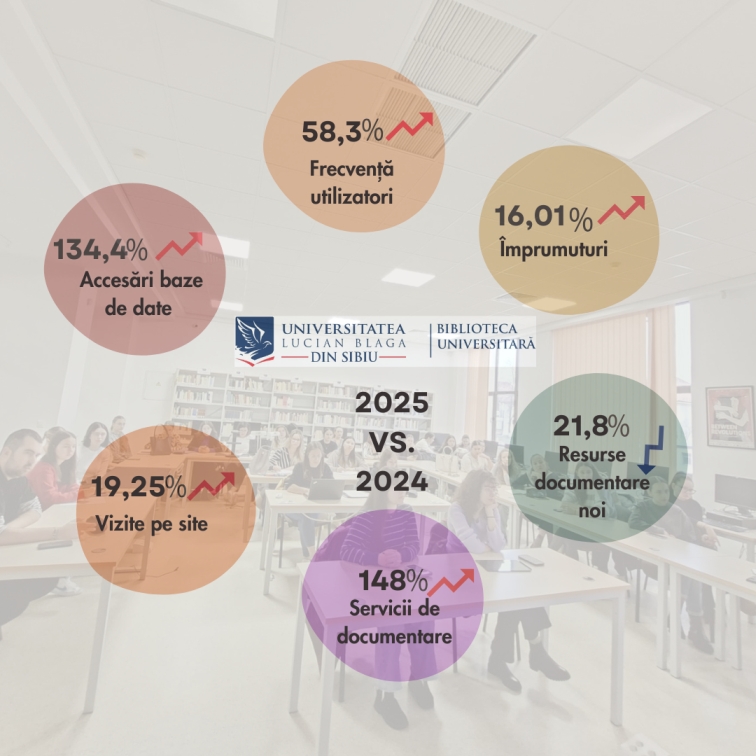
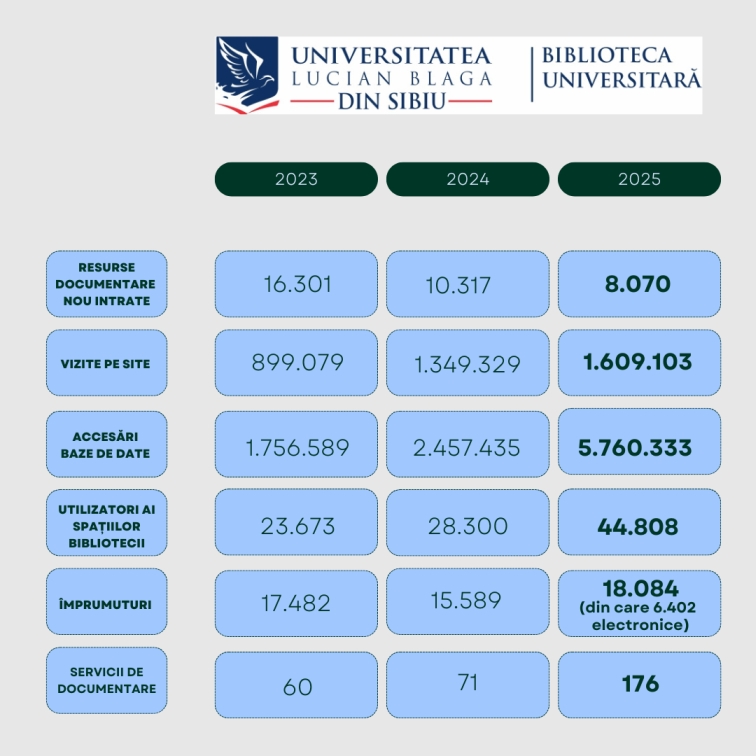
In 2025, the library recorded 44,808 entries, compared to 28,300 in 2024, representing a 58.3% increase and marking the first year in which attendance consistently surpassed pre pandemic levels. The reading rooms on the upper floors registered 25,214 users, the ground floor and attic spaces 16,712 users (compared to 10,034 in 2024), and the individual and group study rooms were used by 2,882 people, an increase of over 40% from the previous year. This evolution is a direct consequence of sustained efforts in transforming and reconfiguring workspaces, modernizing infrastructure, and intensifying the promotion and communication of library services.
Documentation services experienced remarkable growth in 2025. A total of 176 thematic bibliographies were prepared, compared to 71 in 2024—an increase of approximately 148%. More than 6,000 references and articles were provided, and 23 InfoREF sessions brought together 381 participants. These figures indicate a deeper integration of the library into the research process and a growing demand for personalized academic support.
At the same time, through the interlibrary loan service, the library facilitated extended access to documents outside its own collection. In 2025, 146 resources requested by library users were obtained, and 117 resources were supplied to partner libraries. This exchange confirms the active functioning of the interlibrary cooperation network and strengthens the role of the ULBS Library as a relevant node in the national circuit of scientific documents and information.
The digital dimension of the library’s activity recorded in 2025 its strongest growth in recent years. Website traffic increased steadily: while 2023 saw 899,079 accesses and 2024 recorded 1,349,329 accesses and 34,018 unique visitors, in 2025 the platform registered 51,451 unique visitors, 432,790 pages accessed, 85,434 views, and 1,609,103 clicks, confirming the consolidation of online channels as the main vector for information and access to resources.
Access to subscribed databases grew rapidly, from 1,756,589 accesses in 2023 to 2,457,435 in 2024, and to 5,760,332 in 2025. The increase in 2025 represents a growth of over 134% compared to 2024 and over 228% compared to 2023, indicating the increasingly strong integration of digital resources into teaching and research activities.
Compared to 2024, a significant structural shift can also be observed in how databases are accessed. In 2024, there were 604,635 accesses from the university network and 1,852,800 from mobile or home networks—a difference of over 1.2 million in favor of remote use. In 2025, accesses from the university network increased to 2,778,656, while those from mobile or home networks reached 2,981,676, reducing the difference to approximately 203,000 accesses. The gap between on campus and remote/mobile access decreased by over one million accesses, reflecting a balanced usage pattern and the consolidation of a mature hybrid model, more strongly connected to the university’s infrastructure.
The digitization process continued, with 578 books and 213,136 pages scanned in 2025, along with over 250 on demand scanning requests, supporting rapid access to electronic resources. At the same time, user behavior continues to shift: physical loans decreased by 23.13% compared to the previous year, while access to electronic resources increased significantly, confirming the migration toward digital formats.
Regarding collection development, the ULBS Library’s electronic catalog grew by 8,070 documentary resources, compared to 10,317 in 2024 and 16,301 in 2023. In 2025, the collection development policy prioritized the acquisition of new publications and resources requested directly by faculty, researchers, and students, in line with the needs of teaching and research activities. In this context, the library adopted a more rigorous policy regarding book donations, considering the limited space available for collection growth and the need to select donations based on their usefulness to the academic community. For the same reasons of space and efficient collection use, the library cannot accept all types of donations nor systematically increase the number of copies of the same title. Where possible, access to certain works is also ensured through electronic versions or digital reproductions made on request.
In the second part of the year, acquisition activities were also influenced by government imposed austerity measures and the temporary suspension of purchases within certain research projects and other funding lines. The reduction in the total number of items added to the collections does not reflect a decrease in academic needs but rather an adaptation to this restrictive financial context.
The reduction of library spaces, initiated the previous year, continued to generate logistical pressures in 2025. Space for expanding the social sciences and humanities collections became extremely limited, running into a constraint in the second quarter. In this context, efficient reorganization solutions were implemented. One day loan copies in History, Politics, and Law were moved to the ISCI Room, damaged publications were selected for withdrawal, the Public Administration collection was relocated, and unfrequented publications were transferred to the Cultural Centers’ Depot. These measures enabled the creation of an expanded Social Sciences area and ensured approximately 30% growth space for each collection. Conditions were also created for integrating the Islamic Studies collection and relocating Library Science, while 359 volumes (17 titles) were transferred to the Faculty of Medicine – Nursing Center.
The year 2025 was challenging and demanding, marked by austerity measures, difficulties in the acquisition process, and reduced space for collections—factors that exerted constant pressure on the library’s activity. In this context, reduced acquisitions and administrative blockages affected the normal pace of collection development, while the continuous reorganization of spaces required considerable logistical and professional effort.
Nevertheless, through the sustained involvement of staff and the optimization of internal organization, the library succeeded in achieving significant increases in attendance and service usage, as well as a marked intensification of access to digital resources. These developments confirm the institution’s relevance within the academic community but also highlight that maintaining this level of performance and service quality depends on the regular resumption of acquisitions and on ensuring adequate human resources, ensuring continuity through the renewal of roles held by soon to retire staff.
More details here in the romanian full report.
Announcement March 2026